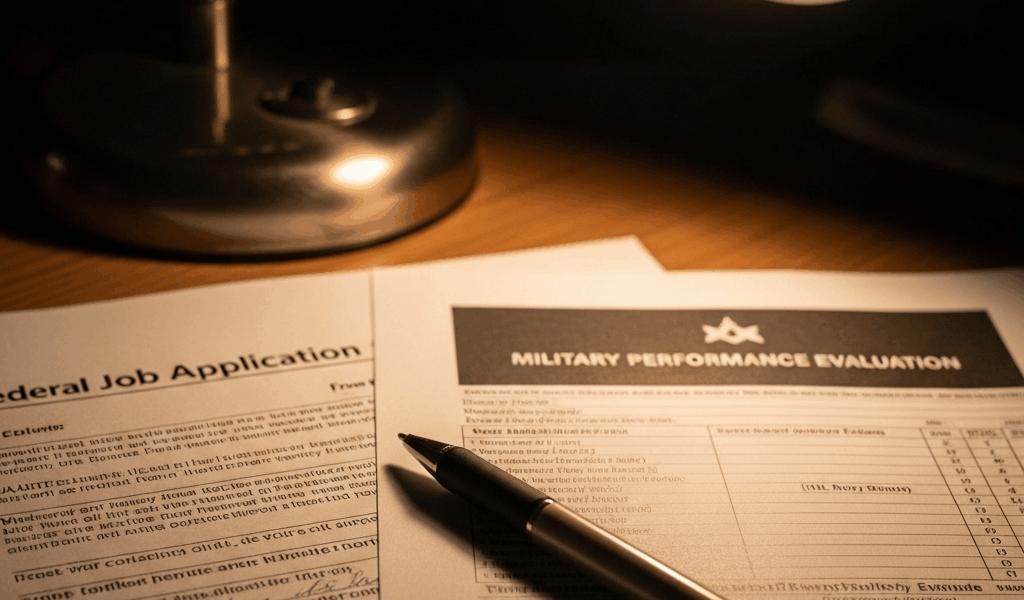
What KSAs Actually Are and Why They Trip Veterans Up
Federal job hunting has gotten complicated with all the conflicting advice flying around. And nowhere is that more obvious than the KSA section — the part of federal applications that chews up qualified veterans and spits them out before a single interview happens.
As someone who spent eight years recruiting federal contractors before moving into veteran transition support, I learned everything there is to know about why strong military candidates keep getting screened out. Today, I will share it all with you.
But what is a KSA? In essence, it’s an evaluation framework — Knowledge, Skills, and Abilities — that federal HR staffers use to score your application before you ever talk to a hiring manager. But it’s much more than that. KSAs are the actual gatekeeping mechanism of the federal hiring system. They live in two spots on USAJobs postings: sometimes as explicit written prompts asking you to describe how you meet each criterion, and sometimes buried inside the “How You Will Be Evaluated” section or the specialized experience block.
Probably should have opened with this section, honestly — the federal system doesn’t reward task completion. It rewards demonstrable impact tied to specific criteria in the job announcement. When you write “Responsible for supply chain operations,” a federal rater reads generic. When you write about reducing delivery delays by 18 percent through process redesign, or preventing $240,000 in inventory loss through auditing protocols you personally implemented, suddenly they see evidence of real ability.
Here’s where veterans consistently go wrong. You’re trained to report what you did. Performance reviews say things like “Managed inventory of 47,000 line items” or “Supervised team of 12 personnel.” Useful context. Not a KSA response. Not even close.
That distinction cost me my first federal application. I applied for a GS-12 contract specialist role after legitimate military procurement experience and submitted what was essentially a bulleted list of job duties. Didn’t get referred. Three months later, working with a federal resume writer who charged me $650 and was absolutely worth it, I reframed the exact same experience as CCAR narratives — more on that format in a moment — and hit the referral list within weeks. Same person. Same background. Completely different framing. Don’t make my mistake.
How to Read a Job Announcement for KSA Clues
Before writing a single word of your KSA response, you need to extract the actual evaluation criteria from the posting itself. Most veterans skim for the GS level and job title, then jump straight to the application. That’s backward.
Open the announcement. Scroll past the summary. Find the section labeled “How You Will Be Evaluated” — sometimes it says “Evaluation Method” instead. This is where HR tells you exactly what they’re scoring. You’ll see language like:
- Ability to manage multiple competing priorities
- Knowledge of supply chain management principles
- Skill in written communication
- Ability to work effectively with cross-functional teams
Copy those phrases verbatim into a separate document. Those are your KSA headings. Every single one.
Next, find the “Specialized Experience” block under “Qualifications.” This is federal code for “here’s what we actually need you to have already done.” Pull out the specific capabilities mentioned. If the announcement says “experience managing personnel in a matrix reporting structure,” that is not interchangeable with “team leadership.” Federal HR reads for exact phrases when scoring written responses. I’m apparently hypersensitive to this stuff now, and that phrase-matching habit works for me while broad paraphrasing never does.
The mistake most veterans make is translating military language into civilian equivalents without checking the announcement first. Your MOS description might say “Combat Support Operations” but the job announcement asks for “Tactical Planning and Execution.” Match the announcement’s vocabulary, not your service record’s vocabulary.
Write down 5–7 key phrases from the announcement. Those become your talking points. You’re not reinventing your background — you’re proving you already have what the job requires, using the job’s own words to do it.
The CCAR Method — Turn Your MOS Into KSA Responses
CCAR is the federal standard for KSA responses: Context, Challenge, Action, Result. The Office of Personnel Management actually teaches this format in their own hiring guidance. Federal raters expect it even when the announcement never explicitly mentions it.
Context: Set the scene in 2–3 sentences. Your position, the organization, the scope of responsibility.
Challenge: What specific problem required you to actually demonstrate the KSA in question?
Action: What steps did you take? Names of methodologies, tools, frameworks, processes — specifics matter here more than anywhere else.
Result: Quantified outcome. Percentage. Dollar figure. Timeline. Federal raters need evidence that your action generated measurable change. “Improved efficiency” is not a result. A number is a result.
So, without further ado, let’s dive in with a concrete example. Picture an E-7 logistics NCO applying for a GS-11 position in supply chain management. The announcement lists this KSA: “Ability to manage inventory systems and reduce operational costs.”
Weak Version (What Most Veterans Write)
“I was responsible for managing inventory for a battalion-level supply operation. I oversaw 47,000 line items and supervised 12 personnel. I implemented tracking procedures and worked with my team to ensure accountability.”
That’s all Context and vague Action. No clearly stated Challenge. No Result with numbers attached. A federal rater scores this as “meets basic requirements” at best — which means you’re not getting referred.
Strong Version (CCAR Format)
“As the Supply Sergeant for the 2nd Battalion Supply Section at Fort Hood, I managed inventory control for 47,000 line items valued at $8.2 million across four warehouse locations. The battalion was running a 12-percent discrepancy rate between recorded inventory and physical counts, creating supply shortages and costing roughly $180,000 annually in emergency reorders. I redesigned the cycle counting process by implementing a weekly rotating audit schedule using the RFID tracking system already on hand but almost completely underutilized by the previous team. I trained all 12 inventory specialists on the new protocol and established monthly reconciliation meetings to identify root causes of recurring discrepancies. Within six months, we reduced the discrepancy rate to 2.1 percent and eliminated emergency reorders entirely, saving the battalion $156,000 in annual costs while pushing supply availability to 98 percent.”
Notice the difference. A specific challenge — 12-percent discrepancy rate. A concrete method — RFID system, weekly audits, $0 in additional equipment cost. Quantified results — 2.1 percent final rate, $156,000 saved, 98 percent availability. A federal rater can score that response because it demonstrates the KSA with hard evidence, not assertions.
That’s what makes the CCAR format endearing to us veterans, honestly — it’s basically a mission brief. Situation, problem, execution, outcome. You already know how to think this way.
Write 2–3 CCAR responses per major KSA. You’re building a narrative bank you can deploy across multiple applications. Three supply chain-related KSAs might require 6–9 well-developed statements total — but you’ll reuse them across multiple postings. That’s the whole point.
Common KSA Writing Mistakes Veterans Make
Four mistakes show up consistently in veteran KSA submissions. All four are fixable.
Mistake 1: Vague Impact Statements — “I improved efficiency” without saying by how much. Fix: attach a number every single time. If you don’t have an exact percentage, estimate conservatively and note your methodology. “Reduced processing time from 45 minutes to 28 minutes per transaction” beats “streamlined operations” in every scoring rubric I’ve seen.
Mistake 2: Military Jargon Without Civilian Translation — “Led COIN operations” means nothing to a federal HR staffer in Baltimore. Fix: translate before you submit. “Led counterinsurgency operations, managing intelligence collection, civilian liaison, and tactical coordination across 47 villages with a team of 18 soldiers.” Spell out what you actually did.
Mistake 3: Acronyms Federal HR Won’t Recognize — You know what S-3 means. A civilian rater in an HR office does not. Fix: spell it out on first reference. “As the S-3 (Operations Officer) for the brigade headquarters.” After that, just say “Operations Officer.” Cleaner anyway.
Mistake 4: Weak Verbs and Passive Voice — “I was involved in developing a new training program” is structurally weaker than “I designed and delivered a 16-week technical training curriculum for 34 personnel.” Fix: active voice, strong verbs. Redesigned. Implemented. Established. Eliminated. Quantified. Those words do work that passive constructions simply cannot.
What to Do If the Job Announcement Has No Explicit KSAs
USAJobs postings have shifted. Some announcements no longer ask for written KSA narratives at all — they use occupational questionnaires instead. Those self-rating scales where you select “Highly Proficient,” “Proficient,” “Familiar,” or “Not Familiar” for various competencies. That was a significant change when it rolled out and it still confuses veterans who prepped for narrative responses.
The same CCAR principles apply. Rate yourself accurately — don’t overstate, federal raters verify claims during interviews and it goes badly when the stories don’t hold up — and then support your rating inside the resume itself.
If you rate yourself “Highly Proficient” in supply chain management, your resume needs to justify that rating. Specific accomplishments, metrics, scope of responsibility in the experience descriptions. Your resume becomes your KSA backup document. Think of it that way and the whole system starts making more sense.
While you won’t need a professional resume writer for every application, you will need a handful of strong, polished CCAR statements ready to deploy. A master document organized by KSA category might be the best option, as federal applications require fast turnaround. That is because good postings close fast — sometimes in five days — and starting from scratch every time will kill your momentum.
First, you should save every strong CCAR response you write — at least if you plan to apply to more than one federal position, which you should. Drop them into that master document organized by category: Leadership, Technical Expertise, Process Improvement, Communication, Budget Management, whatever fits your background. When the next GS-11 supply position opens, you’re adapting proven narratives, not writing cold.
Federal hiring moves slowly. It’s methodical. But it is not mysterious. KSAs are federal HR’s mechanism for confirming you’ve actually done what you claim you’ve done. Answer them like you’re presenting evidence — because you are. That’s how veterans move from “meets basic requirements” to “referred to the hiring manager.” Same background. Different framing. Every time.




Leave a Reply