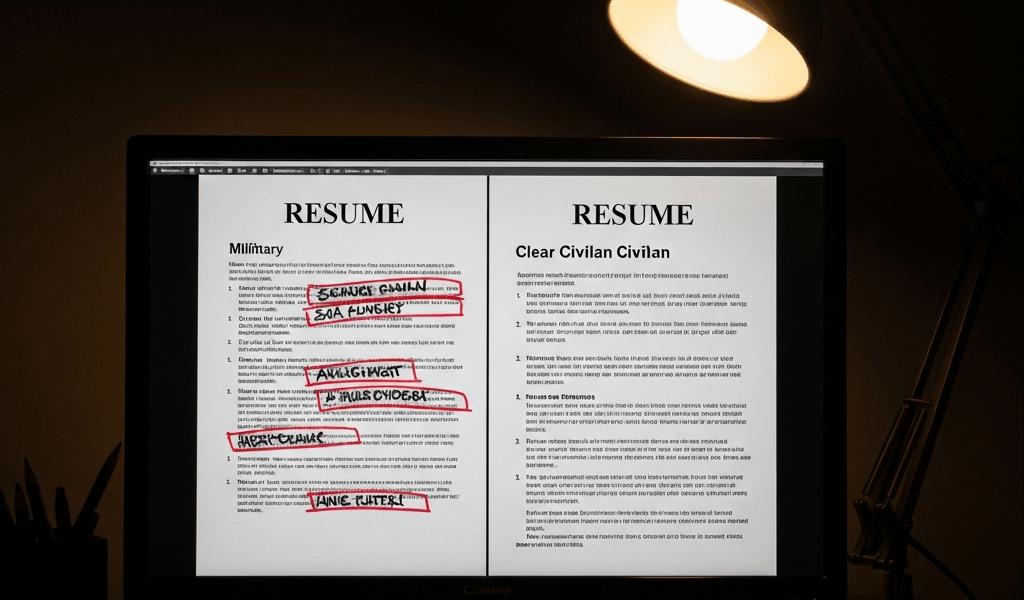
Why the Same Resume That Got You Promoted Will Get You Rejected on USAJOBS
Federal resume writing has gotten complicated with all the conflicting advice flying around — especially for veterans who already have a resume that works. The problem is, it works for the wrong audience. As someone who spent two years at a transition assistance office watching otherwise exceptional candidates crash out of USAJOBS, I learned everything there is to know about why military resumes fail federal hiring systems. Today, I will share it all with you.
The failure is never about writing ability. It is not about being inarticulate or lacking experience. Military resumes are engineered for a specific reader — commanders, senior NCOs, promotion boards — people who see “NCOIC, 68W, 15-month OIF rotation” and immediately know what that person did, at what level, under what conditions. Federal HR specialists are not those people. They are screening dozens of applications against keyword checklists, and if your resume does not hand them the exact language and data fields they need, you disappear. Not because you were underqualified. Because the format was wrong for the system.
Length and Scope — Military One Page vs Federal Two or More Pages
Military culture rewards brevity. A tight one-page resume signals discipline and self-awareness in most contexts. Submit that same one-pager to USAJOBS and it signals something else entirely — that you do not understand how federal hiring works. That is a rough first impression to make before anyone reads a single word.
Federal resumes are expected to run two to five pages. That is not bloat. That is the system working exactly as designed. HR specialists use your resume text to confirm you meet the specialized experience requirements listed in the job announcement. They are scanning for keywords that mirror the announcement language almost verbatim. A one-page resume with compressed bullets does not give them enough surface area to make that match — even when the experience is genuinely there.
Here is a concrete example. A military resume might read:
- Managed logistics operations for 240-person battalion
That bullet is doing real work in a military context. In a federal resume, that same experience needs to look more like this:
- Managed end-to-end logistics operations supporting a 240-person battalion, including supply chain coordination, property accountability for over $2.3 million in equipment, transportation scheduling, and inventory reconciliation. Supervised a team of 12 supply specialists. Reduced equipment loss rate by 18 percent over 12 months by implementing a new hand-receipt tracking process across all subordinate units.
Same job. Completely different level of detail. The federal version gives a GS-7 reviewer the language needed to check boxes — who you managed, what the dollar scope was, what measurable result you produced. That structure is not optional. It is the whole game.
Acronyms, Jargon, and Job Titles — What HR Cannot Decode
I am still stumped by how often I see this mistake. Veterans spend years earning titles and qualifications that carry enormous weight inside the military — and then hand a resume full of those terms to someone who has never worn a uniform, expecting them to infer the meaning. They cannot. And they will not try.
Here are common military terms that land flat on a federal resume, and what to write instead:
- NCOIC — Write “Non-Commissioned Officer in Charge” on first use, then follow immediately with plain-language description: “supervised daily operations of a six-person team responsible for…”
- OIC — Write “Officer in Charge” and add scope: “served as Officer in Charge of a forward operating base communications section with 24/7 operational responsibility”
- MOS 25U — This means nothing to a federal HR specialist. Nothing. Translate it: “Signal Support Systems Specialist responsible for installation, maintenance, and troubleshooting of tactical radio and network communications equipment”
- SIGINT — Spell it out as “signals intelligence” and connect it to federal job series language — GS-0132 (Intelligence) uses terms like “collection,” “analysis,” and “reporting” that you should mirror directly
- PCS/TDY — Write “permanent change of station relocation” or “temporary duty assignment” — HR may recognize these, but do not assume
- E-7, O-3, GS equivalent — Do not make HR guess at your pay grade. If you were an E-7, describe the scope of your responsibility in plain terms or note the GS-equivalent in parentheses if you know it confidently
The goal is not to dumb anything down. The goal is to match the vocabulary of the job series you are targeting. Pull language directly from the OPM position classification standard for that series and use it. That is what makes this approach endearing to veterans who apply it — it is not spin, it is translation.
The Missing Fields That Kill Your Application Before It Is Read
Probably should have opened with this section, honestly. These omissions trigger automatic disqualification on USAJOBS before a human ever looks at your application. The resume builder has required fields for a reason. Veterans submitting a formatted PDF or Word document often skip them entirely — and the system quietly filters them out.
Check every single position on your resume for these fields:
- Hours per week — Federal experience is calculated based on hours worked. No hours listed means it may not count toward eligibility. Write “40 hours per week” or whatever is accurate.
- Exact start and end dates with month and year — “2018–2020” is not enough. Write “March 2018 – November 2020.” USAJOBS calculates specialized experience in months and cannot do that math without months.
- Salary or pay grade — List your ending base pay or military pay grade. This verifies progression and eligibility, and leaving it blank raises flags.
- Supervisor name and contact information — Required field. Include name, phone number, and whether they may be contacted. Do not leave it blank and assume no one checks.
- Employer name and location — “U.S. Army” is not a complete entry. List the unit, installation, and city/state. “HHC, 2-87 Infantry, Fort Drum, NY” is a complete entry.
- Series and grade if applying from federal civilian experience — Relevant if you have had any prior GS or WG employment that should count toward eligibility.
I watched veterans with genuinely exceptional records — combat deployments, graduate degrees, active TS/SCI clearances — get screened out automatically because they listed “2019–2021” with no months and no hours per week. The system flagged insufficient specialized experience. It was not insufficient. It was incomplete data entry. Don’t make my mistake of thinking the system will give anyone the benefit of the doubt.
How to Rebuild Your Military Resume Into a Federal Resume That Clears the Screen
Frustrated by watching strong candidates lose to bad formatting, I started walking veterans through a five-step conversion process using nothing more than the job announcement, OPM’s website, and a willingness to write longer sentences than felt comfortable. This new approach took hold over several years and eventually evolved into the process that transition counselors and veteran hiring advocates actually use today.
So, without further ado, let’s dive in.
- Start with the job announcement, not your resume. Read the entire announcement. Copy every phrase under “specialized experience” and “duties” into a separate document. These are your target keywords — the exact ones a reviewer will scan for.
- Match each military role to a GS series. Go to OPM.gov and find the position classification standard for the series you are targeting — 0343 Management Analyst, 0080 Security Administration, 2210 IT Management, whatever applies. Read how OPM describes work at that grade level. Use that language in your resume, not military language.
- Expand every bullet using who-what-result structure. Who did you lead or coordinate with? What specific tasks did you perform? What measurable result came from it? Write at least three to five sentences per major bullet. One sentence is not enough — at least if you want a reviewer to be able to confirm your eligibility on paper.
- Add every required field for every position. Hours per week. Month and year dates. Supervisor contact information. Salary or pay grade. Physical location. No exceptions.
- Tailor each application separately. One federal resume does not work for every announcement. A resume targeting a GS-11 Logistics Management Specialist and a GS-11 Program Analyst need different keyword emphasis — even when the underlying experience is identical.
I’m apparently someone who has seen this process work dozens of times, and the USAJOBS resume builder works for me while a standalone Word document upload never quite does. The fields just get completed properly when you build inside the system.
The next step is simple. Pull one job announcement you want to apply for right now. Open your current resume beside it. Count how many of the specialized experience keywords appear in your resume text verbatim. Fewer than five? The resume needs work before you hit submit. Start with the expansion step — one role, fully rebuilt with scope and results — and you have a template for every role that follows.




Leave a Reply