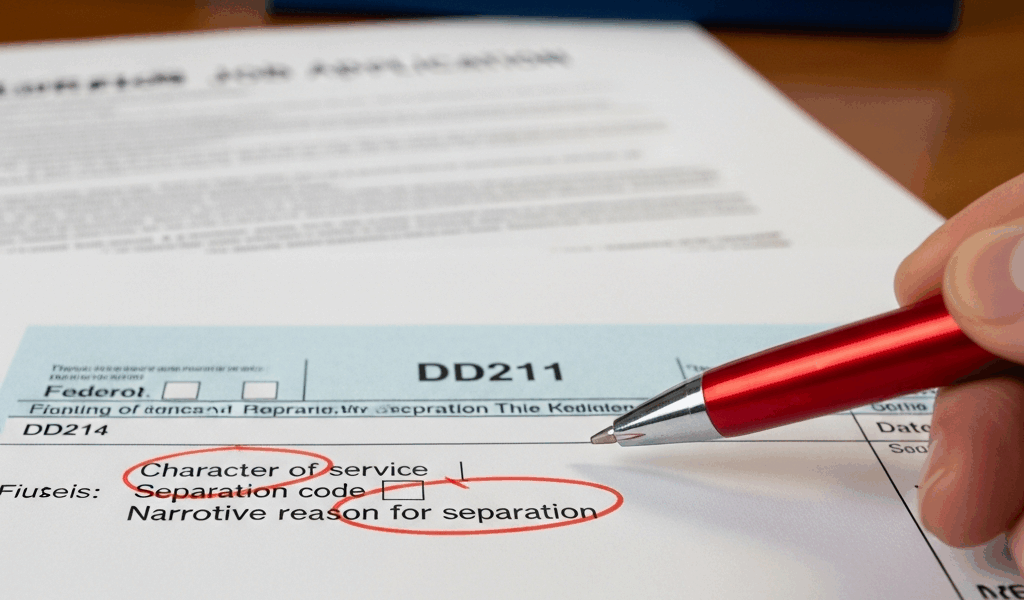
DD214 Errors That Kill Your Federal Job Application
Federal hiring has gotten complicated with all the bureaucratic noise flying around — and veterans are paying the price for paperwork they didn’t even create. I spent four years helping veterans navigate federal hiring after my own discharge, and I learned everything there is to know about how a single mistyped character can derail an entire application. Today, I will share it all with you.
Most DD214 errors that sink a federal job application have nothing to do with your actual service. A wrong discharge code. A separation date off by a week. A reentry eligibility code that went missing somewhere between your separating unit and the system OPM pulls from. These aren’t fraud problems. They’re bureaucratic hiccups the military created — but the veteran absorbs when the hiring timeline stalls.
The federal government doesn’t care that your service was honorable if Box 24 says something different. What matters is whether the document in the system matches what HR needs to verify your veterans preference claim. Most veterans don’t know which boxes even matter until they’ve submitted an application and heard nothing back for six weeks. Don’t make my mistake.
Which DD214 Fields Actually Affect Federal Hiring
Box 24 — Character of Discharge. This is the first thing HR pulls. “Honorable” gets you five-point veterans preference — ten points if you’re service-connected disabled. “General Under Honorable Conditions” is still preference-eligible, but some hiring managers flag it anyway because they genuinely don’t know that. “Other Than Honorable” means zero points, and the application may die before you even realize it happened.
Separation units sometimes abbreviate this field or use outdated codes. I once saw a DD214 that listed “HON” instead of spelling out “Honorable.” The automated verification system rejected it. The full word wasn’t there, so the system didn’t recognize it. That veteran waited nine weeks before anyone figured out what happened.
Box 27 — Reentry Eligibility Code. But what is a reentry eligibility code? In essence, it’s a four-character code telling HR whether you left the military under conditions that allow future re-enlistment or affiliation. But it’s much more than that. Some federal positions — especially DoD contractor work and VA jobs — use this box to screen candidates before the interview stage.
An incorrect code doesn’t directly kill your application, but it delays verification by several weeks while HR manually cross-checks your separation paperwork. Wrong code. Missing code. Code that was valid in 1998 but the military stopped using in 2003. These all slow everything down in ways that are genuinely hard to trace.
Box 29 — Dates of Service. Probably should have opened with this section, honestly. This is where I made my first real mistake. My separation date was listed as one day before my actual separation — which meant I didn’t qualify for the 180-day employment window after discharge. That’s a critical threshold for certain federal positions. The error came from the separating unit’s admin staff. Three months to fix. If I’d caught it before applying, I’d have saved myself a rejected referral and a frustrating paper trail that went nowhere fast.
Common Errors That Trigger a Preference Rejection
- Wrong discharge character code. “General Under Honorable” mistyped as “General Discharge” — not preference-eligible, completely different category. “Honorable” listed as “Other Than Honorable” due to a data entry error at the separating unit. Character of discharge is not something you appeal to OPM. You have to fix the source document. Full stop.
- Incomplete or missing medals. Some federal positions — especially DoD — require specific medals as baseline qualifications. Missing the Iraq Campaign Medal or the Navy Expeditionary Medal on your DD214 means disqualification, even if you earned it and your service record proves it. Separating units omit medals when discharge paperwork isn’t processed correctly. It happens more than it should.
- Separation date errors. Off by a week. Off by a month. I’ve seen dates listed as the last day of the month before the actual discharge. This pushes veterans out of the 180-day window or drops them into a different hiring category entirely. Always correctable — but only if you catch it first.
- Branch of service abbreviation confusion. “Air Force” written as “AF” when the system expects “USAF.” “Navy” listed as “USN” instead of “US Navy.” These sound trivial until HR’s automated verification can’t match the text string and flags the application for manual review — which can take weeks, or quietly never happen at all.
- Missing or incorrect reentry codes. Some federal positions require a specific reentry code to confirm you separated under conditions that allow future military affiliation. No code, or a code that doesn’t match the character of discharge, and HR has to do extra legwork that most HR offices don’t have bandwidth for right now.
How to Check Your DD214 Before You Apply
Pull your DD214 right now — specifically Member Copy 4 or Member Copy 1. These are the versions HR specialists expect to see. The Separation Authority Copy and other variants sometimes have different formatting, and automated systems don’t always accept them. So, without further ado, let’s dive in.
- Box 24: Write down exactly what it says. “Honorable.” “General Under Honorable Conditions.” “Under Other Than Honorable Conditions.” Match it against your actual understanding of how you separated. Any mismatch — flag it immediately.
- Box 27: Is there a four-character code? Does it make sense for your rank, branch, and reason for separation? If it’s blank or looks unusual, cross-reference your service record summary or your separation orders directly.
- Box 29: Compare the exact dates against your actual separation orders or the date you received your discharge paperwork. One day off matters. Note any discrepancy.
- Boxes 13–15: Every service medal and campaign medal you earned should be listed here. If something’s missing, check your service record or separation documents before applying anywhere.
- Box 8: Branch of Service. Spelled out fully or abbreviated? Make sure the format matches your other military documents — consistency is what the automated systems check for.
I’m apparently someone who needed to learn this the hard way, and auditing my DD214 before applying works for me now while scrambling to fix errors mid-application never did. Most veterans don’t look at these boxes until they’ve already hit a hiring wall. Don’t be most veterans.
How to Fix a DD214 Error Using DD Form 149
Found an error? Submit DD Form 149 — the Application for Correction of Military Records — to the National Personnel Records Center, commonly called NPRC. Standard processing runs 6 to 12 months. Not ideal when you need the correction last Tuesday, but it’s the official path and the only one that holds up.
Here’s what strengthens your request: a copy of your service record (NGB Form 22 or equivalent), a copy of your separation orders, and a written explanation of why the error occurred. The stronger your documentation package, the faster NPRC moves. Include any emails or correspondence from the separating unit that acknowledge the error was on their end — this removes any fraud question and makes the correction nearly automatic.
One detail most articles skip entirely: if you have a pending federal job offer, you can request expedited review. NPRC will sometimes process a correction within 30 to 60 days if you provide written proof that a federal position is contingent on the fix. Contact NPRC’s expedite desk directly — bring your job offer letter and a note confirming you have a conditional hire pending background investigation clearance. That combination moves things faster than a standard submission.
What to Do If Your Application Is Already Moving
You’re already in the pipeline. You’ve passed initial screening. Then you catch the error. Don’t wait for NPRC to finish processing — contact the HR specialist assigned to the position directly. Use email. Provide your NPRC case number. Here’s a professional approach that actually works:
“I am writing to notify you that I have submitted DD Form 149 to correct an error on my DD214 (Box 24 — Character of Discharge). My NPRC case number is [number]. I expect the correction to be processed by [date]. I have attached documentation of the error and the pending correction request. Please let me know if you need any additional information to keep my application in processing during this correction period.”
That’s what makes this approach endearing to us veterans navigating federal hiring — it keeps you on the referral list while showing HR you’re transparent and proactive. It also creates a paper trail, which matters if something goes wrong later. Document every contact in writing. Follow up in writing. Never leave a hiring manager guessing about your status or your integrity — because in federal hiring, ambiguity almost always resolves against the applicant.



Leave a Reply